
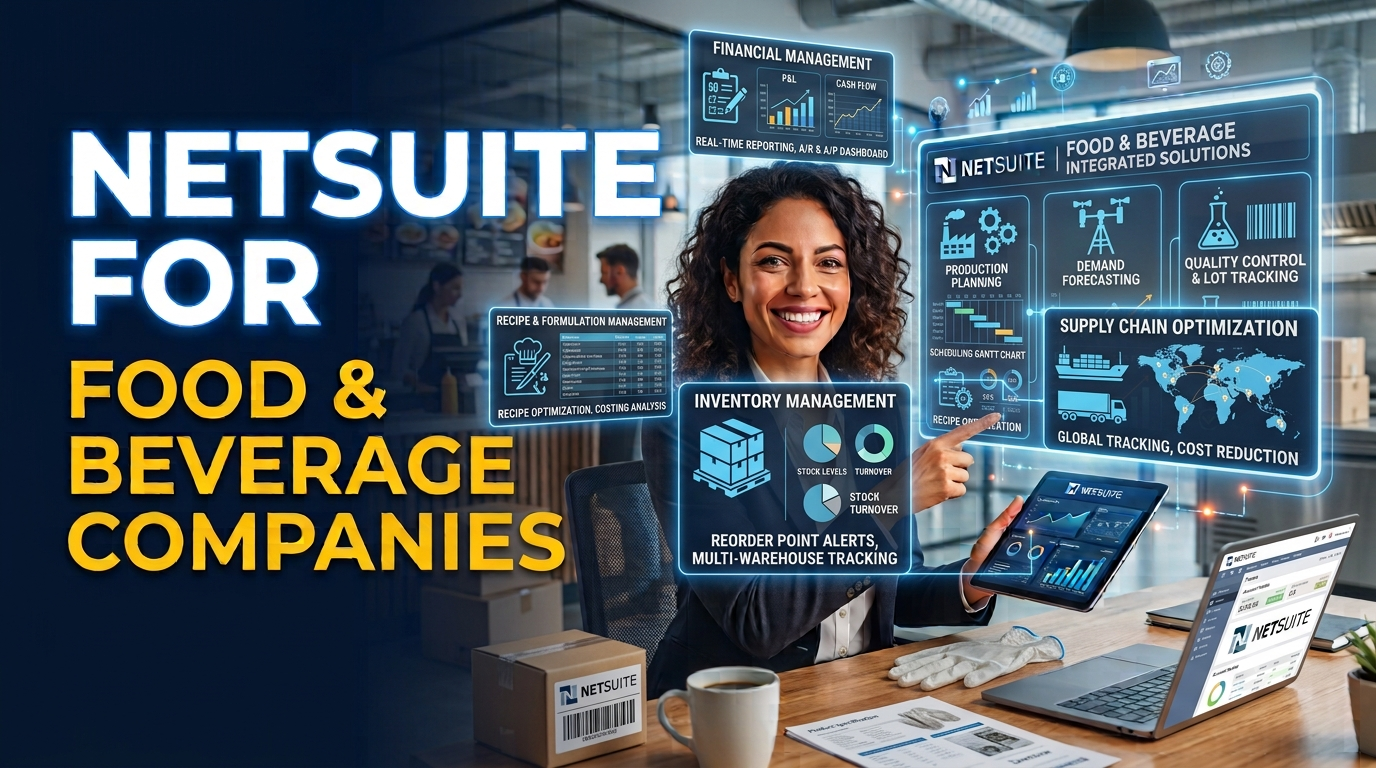
The Food & Beverage (F&B) industry is evolving faster than ever. Consumer preferences change rapidly, supply chains are becoming more complex, regulatory compliance is stricter, and customers expect faster deliveries, fresher products, and complete transparency.
While these challenges create opportunities for growth, they also expose weaknesses in traditional business systems.
Many food manufacturers and distributors still rely on spreadsheets, disconnected accounting software, and manual inventory tracking. These systems may work during the early stages of a business, but as operations expand, they become difficult to manage.
This is where Oracle NetSuite becomes a game-changer.
As a cloud-based ERP platform, NetSuite helps Food & Beverage businesses unify finance, procurement, production, inventory, warehousing, sales, and customer management into one integrated system.
Whether you’re a packaged food manufacturer, beverage producer, frozen food supplier, spice exporter, dairy company, or D2C food brand, NetSuite provides the visibility and automation needed to scale efficiently.
Challenges Faced by Food & Beverage Companies
Growth in the F&B sector often introduces operational complexity.
Some of the most common challenges include:
- Managing perishable inventory
- Tracking batch and lot numbers
- Maintaining product traceability
- Forecasting seasonal demand
- Controlling food production costs
- Vendor management
- Regulatory compliance
- Warehouse optimization
- Multi-channel order management
- Profit margin visibility
When these processes are managed across multiple systems, businesses spend more time resolving issues than focusing on growth.
Why NetSuite Is a Strong Fit for Food & Beverage Businesses
NetSuite provides a centralized platform where every department works with the same real-time data.
Instead of maintaining separate systems for finance, inventory, procurement, and operations, teams collaborate using one source of truth.
This enables faster decisions, improved efficiency, and better customer service.
1. Complete Inventory Visibility
Inventory is one of the most valuable assets for Food & Beverage companies.
Managing inventory manually often results in:
- Overstocking
- Stock shortages
- Product expiry
- Excess waste
- Poor warehouse utilization
NetSuite provides real-time inventory visibility across:
- Warehouses
- Distribution centers
- Retail locations
- Manufacturing facilities
Businesses always know:
- Current stock levels
- Available inventory
- Inventory value
- Reorder points
- Product movement
This improves inventory accuracy while reducing carrying costs.
2. Batch, Lot, and Expiry Tracking
Food safety requires complete product traceability.
NetSuite supports:
- Batch tracking
- Lot tracking
- Expiry date management
- Product genealogy
Businesses can quickly identify:
- Which customers received a specific batch
- Supplier source information
- Manufacturing dates
- Expiration dates
In the event of a product recall, businesses can respond faster while minimizing operational disruption.
3. Better Demand Forecasting
Food demand is rarely consistent.
Sales fluctuate due to:
- Seasonal trends
- Festivals
- Weather conditions
- Promotional campaigns
- Consumer behavior
NetSuite helps businesses forecast demand using historical sales data and operational insights.
Improved forecasting reduces:
- Stockouts
- Excess inventory
- Emergency procurement
- Lost sales opportunities
4. Procurement Optimization
Food manufacturing depends on efficient procurement.
NetSuite helps businesses:
- Manage supplier relationships
- Automate purchase requests
- Track purchase orders
- Monitor vendor performance
- Control procurement costs
This creates greater purchasing efficiency while improving supplier accountability.
5. Production Planning and Manufacturing
NetSuite enables manufacturers to manage:
- Bills of Materials (BOM)
- Production orders
- Work orders
- Resource planning
- Material consumption
- Production scheduling
Production teams gain greater visibility into manufacturing operations, helping reduce delays and improve throughput.
6. Warehouse Management
As businesses grow, warehouse operations become increasingly complex.
NetSuite helps optimize:
- Receiving
- Put-away
- Picking
- Packing
- Shipping
- Inventory transfers
Warehouse staff benefit from more efficient workflows, improving order accuracy and reducing fulfillment time.
7. Financial Management
Food businesses often operate on tight margins, making real-time financial visibility essential.
| Financial Feature | Business Benefit |
|---|---|
| General Ledger | Centralized financial records |
| Accounts Payable | Improved vendor payment management |
| Accounts Receivable | Faster collections and cash flow |
| Cash Flow Reporting | Better financial planning |
| Budgeting | Improved financial control |
| Financial Consolidation | Unified reporting across entities |
Executives gain immediate access to business performance without waiting for manual reports.
8. Multi-Channel Sales Management
Today’s Food & Beverage brands sell through multiple channels, including:
- Retail distributors
- Modern trade
- Supermarkets
- Direct-to-Consumer (D2C) websites
- Online marketplaces
- Wholesale customers
NetSuite centralizes order management, ensuring inventory, pricing, and customer information remain synchronized across all sales channels.
9. Regulatory Compliance
Food businesses operate under strict regulatory requirements.
NetSuite supports compliance by improving:
- Record keeping
- Audit trails
- Batch traceability
- Quality documentation
- Financial reporting
This helps organizations maintain stronger governance while preparing for audits with confidence.
10. Business Intelligence and Dashboards
Decision-makers need more than reports—they need actionable insights.
NetSuite dashboards provide visibility into:
- Sales trends
- Inventory turnover
- Gross margins
- Vendor performance
- Production efficiency
- Customer profitability
Executives can monitor KPIs in real time and make informed decisions based on current business performance.
Who Can Benefit from NetSuite?
| Industry Segment |
|---|
| Packaged Food Manufacturers |
| Beverage Companies |
| Dairy Producers |
| Bakery Businesses |
| Frozen Food Manufacturers |
| Spice & Seasoning Brands |
| Snack Manufacturers |
| Organic Food Brands |
| Health & Nutrition Companies |
| Restaurant Supply Distributors |
| FMCG Companies |
| D2C Food Brands |
Signs Your Food Business Has Outgrown Spreadsheets
You may be ready for an ERP solution if:
- Inventory numbers frequently don’t match physical stock.
- Product expiry leads to unnecessary waste.
- Financial reporting takes days instead of hours.
- Procurement approvals are slow and manual.
- Order fulfillment errors are increasing.
- Sales channels are disconnected.
- Production planning lacks visibility.
- Teams rely heavily on Excel for daily operations.
Why Growing Food Businesses Choose NetSuite
NetSuite provides:
- Cloud accessibility
- Real-time visibility
- Automated workflows
- Scalable architecture
- Strong financial controls
- Multi-location support
- Multi-subsidiary capabilities
- Global business support
As operations expand, NetSuite grows alongside the business without requiring multiple disconnected systems.
Final Thoughts
The Food & Beverage industry demands speed, accuracy, compliance, and operational efficiency.
Businesses relying on disconnected systems often struggle with inventory issues, production delays, manual reporting, and limited visibility.
NetSuite brings every critical business function together into one integrated platform, enabling companies to reduce operational complexity, improve profitability, and prepare for sustainable growth.
Whether you’re manufacturing packaged foods, distributing beverages, running a D2C food brand, or managing a nationwide wholesale network, investing in the right ERP system can become a significant competitive advantage.
Ready to Modernize Your Food & Beverage Business?
At Creative Solutions Tecnovate India Services Pvt. Ltd., we help Food & Beverage companies across India, the USA, and Europe implement, customize, and optimize NetSuite to meet their unique operational needs.
From ERP implementation and procurement automation to inventory management, manufacturing workflows, integrations, and ongoing support, our experienced consultants work closely with your team to build a solution that scales with your business.
If you’re planning your digital transformation journey, we’d be happy to help you design the right NetSuite strategy for your organization.
